Jacksonville to Houston: 2026 Tax + Energy Career Guide
Moving from Jacksonville to Houston for energy industry, no-income-tax peer, or family. Suburb mapping, climate trade, direct-service interstate logistics.
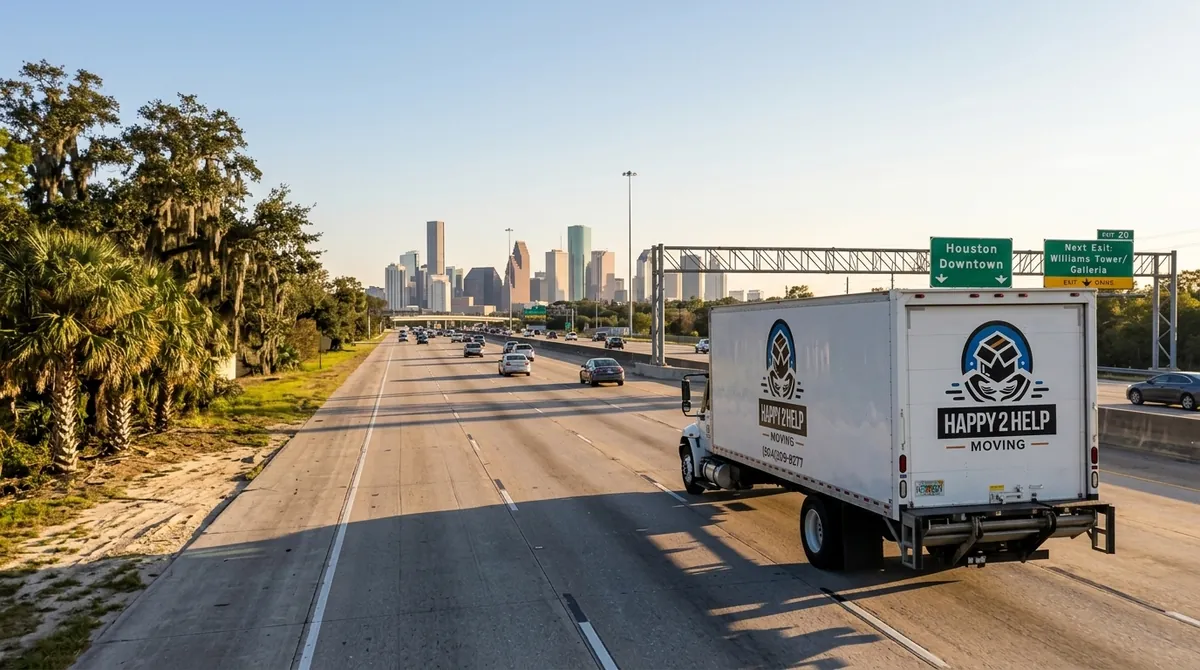
Why Floridians move to Houston
The Jacksonville-to-Houston relocation flow in 2026 is dominated by three driver categories: energy industry careers (oil, gas, petrochemical, renewables — Houston is the global capital), healthcare and aerospace (Texas Medical Center, NASA Johnson Space Center), and family reunification (Houston’s deep Texas-roots demographic).
The financial draw is real: Texas keeps you in the no-income-tax tier with Florida, the Houston job market is the largest in the South, and energy-sector compensation tops most Florida industries. The lifestyle trade is real too: you give up the Atlantic Coast, beaches, and Northeast Florida’s coastal geography for inland coastal plain.
This guide is the Floridian’s version of the Jacksonville-to-Houston move. Tax math, suburb mapping, climate reality, and what an interstate move 950 miles west should actually look like. For the formal route page, see /jacksonville-to-houston-movers/.
Tax-peer math
Texas and Florida share the no-state-income-tax structure. The detailed picture:
- Wages: No state income tax in either state. Identical federal treatment.
- Property tax: Texas statewide effective rate is around 1.6 to 1.8 percent. Florida statewide is closer to 0.8 percent. For new buyers, Texas property tax is roughly double Florida’s. For long-term Florida homestead residents with Save Our Homes cap, the gap widens further in Florida’s favor.
- Sales tax: Texas state sales tax is 6.25 percent plus local add-ons capped at 2 percent (max 8.25 percent effective). Florida is 6 percent state plus local add-ons. Roughly comparable.
- Business taxes: Texas has a franchise tax on businesses above a certain revenue threshold. Florida does not. For self-employed and small-business owners, Florida is generally more favorable.
Net: the Houston move preserves the no-income-tax benefit, but the property-tax delta can offset much of the savings for high-property-value households. Run the math on your specific property value and income profile before assuming Houston is a tax win.
Houston suburb mapping (Jacksonville reference)
Houston’s geography is sprawling — most relocations land in a master-planned suburb rather than the urban core:
| Jacksonville area | Houston equivalent | Why |
|---|---|---|
| Ponte Vedra Beach | Memorial Villages (Hunters Creek, Piney Point, Bunker Hill) | Top schools, executive demographic, walkable to downtown employment |
| Nocatee | The Woodlands (35 mi north of downtown) | Master-planned, newer construction, family-suburban, top schools |
| World Golf Village / St. Johns | Cinco Ranch / Katy area | Master-planned, golf-community character, family-oriented |
| San Marco / Riverside | River Oaks / Montrose / Heights | Walkable urban, restaurant density, historic character |
| Fleming Island / Orange Park | Sugar Land | Family-suburban, lower price than Memorial, growing demographic |
| Mandarin | Pearland | Family-suburban Houston-adjacent, newer construction |
| Atlantic Beach | Clear Lake (NASA-adjacent) | Boating/outdoor, water access, professional demographic |
The Woodlands is the single most common Northeast Florida transplant landing zone. Family-suburban, top schools, walkable Market Street center, master-planned similarity to Nocatee. Memorial Villages is the executive Ponte Vedra peer.
Climate trade
Houston climate vs Jacksonville:
- Summer: Houston averages slightly hotter (95F vs 92F) with similar or higher humidity. Daily afternoon thunderstorm pattern is similar to Florida. No ocean breeze moderating effect — Houston is roughly 50 miles inland from Galveston Bay.
- Winter: Milder average lows than Jacksonville, but with sharper cold-snap risk. The February 2021 Texas freeze (record lows, statewide grid failure) is the cautionary tale. Plan for occasional sub-freezing temperatures.
- Hurricanes: Houston sits in the Gulf hurricane corridor. Harvey (2017), Ike (2008), and Beryl (2024) all produced major flooding. The risk is comparable to Northeast Florida’s Atlantic exposure — different storm paths, similar overall annual risk.
- Flooding: Houston’s flat coastal-plain geography drains poorly. Flood-zone awareness matters more in Houston than Northeast Florida — many neighborhoods sit in 100-year or 500-year flood zones. Check the FEMA flood map for any prospective address.
- No beach: The single biggest lifestyle loss for Northeast Florida transplants. Galveston (50 miles south) is the closest Gulf beach — pleasant but not a peer to Ponte Vedra or St. Augustine Beach.
The interstate move — direct-service is the answer
950 miles is the high-risk corridor for broker-consolidated shipments. The damage and delay rates spike on routes longer than 800 miles when goods are consolidated with other customers.
A direct-service mover loads your goods on one truck with one crew, drives to Houston without unloading, and delivers. Three to four days end to end. Single accountability chain. Lower damage rate. No “your shipment is waiting for a delivery window to open” calls.
For any interstate move crossing the Florida state line, verify the mover at safer.fmcsa.dot.gov. Active MC operating authority, insurance on file, recent complaint history under control. The five-minute verification before booking prevents most long-distance moving disasters.
Practical logistics
Route: I-10 west the entire 950 miles — Jacksonville to Tallahassee to Mobile to New Orleans to Beaumont to Houston. Straight shot, no major routing decisions.
Timing: Load day one. Two driving days. Deliver day four. Compressing to three days requires a two-driver team trading off behind the wheel — possible but adds cost.
Insurance: Federal-minimum cargo coverage on interstate moves is $0.60/lb/item — practically nothing. Upgrade to Full Value Protection for any household with valuable contents.
Inventory: FMCSA regulation requires written inventory with condition notes at origin and destination. Insist on it. The inventory is your evidence base if a damage claim is needed.
Vehicles: If you’re shipping a vehicle separately, book the auto-transport carrier separately from your household goods mover. Different regulatory framework (auto transport runs on its own MC authority and tariff structure).
What H2H Moving does on Jacksonville-to-Houston
H2H Moving operates as a direct-service interstate mover on the Jacksonville-to-Houston corridor:
- Written estimate after a real inventory walk (in-home or video)
- Single-truck, single-crew load — no consolidation with other customers
- Three to four day delivery window
- Itemized written inventory at origin and destination
- Full Value Protection insurance options
- Transparent line-item invoicing — what you signed is what you pay
For the formal route page with quote intake, see /jacksonville-to-houston-movers/ or call (904) 209-9277.
Related reading: Cost to move in Northeast Florida 2026 · Why hire a direct-service mover · Jacksonville to Nashville guide · Jacksonville to Charleston guide · Long-distance moving hub
Frequently Asked Questions
Is Texas a no-income-tax state like Florida? add
Yes. Texas has no state income tax on wages, putting it in the same tax-peer category as Florida. Both states fund operations primarily through sales tax, property tax, and business franchise tax. For Jacksonville residents accustomed to no Florida income tax, the Houston move preserves that benefit. The trade-off Texas residents accept is higher property tax — Texas statewide effective rates average around 1.6 to 1.8 percent of assessed value, roughly double Florida's average. For high-property-value Jacksonville households, run the math both ways before assuming Texas is cheaper.
What's the Ponte Vedra Beach equivalent in Houston? add
Memorial Villages — Hunters Creek Village, Piney Point Village, Bunker Hill Village — collectively are the closest Ponte Vedra peer. Top-tier school district zip codes, executive-level relocation concentration, master-planned residential character, walkable to downtown Houston employment. River Oaks is closer to Ponte Vedra Beach's coastal-luxury demographic but is urban rather than suburban. The Woodlands (35 miles north of downtown) is the Nocatee equivalent for families wanting newer master-planned construction, top schools, and family-suburban character. Sugar Land is a third option for families willing to commute slightly farther.
How long is the drive from Jacksonville to Houston for a move? add
Approximately 950 miles via Interstate 10 west — the most direct route. Driving time in a passenger vehicle is about fourteen to fifteen hours; in a commercial moving truck respecting required driver breaks, plan two days of driving (eight hours of driving each day, overnight stop). For a typical Jacksonville-to-Houston household move, the full timeline is load day one, drive days two and three, deliver day four. Brokered consolidated shipments can stretch to ten or fourteen days because tractor-trailers route through multiple destinations. Direct-service movers complete the move in three to four days end to end.
What's Houston's climate like compared to Jacksonville? add
Hotter, more humid in summer, similar hurricane exposure, and missing the Atlantic Coast moderating effect. Houston summers average 95F highs with humidity that rivals or exceeds Florida. Hurricane risk is comparable — both cities sit in the Gulf of Mexico / Atlantic hurricane corridor. Houston winters are milder than Jacksonville on average but can produce sharper cold snaps (the February 2021 freeze knocked out Texas grid). The lifestyle difference is geography — Houston is flat coastal plain without the ocean access, beaches, and barrier-island geography that defines Northeast Florida. If you love the beach, that loss is the biggest practical trade.
Why use a direct-service mover for Jacksonville to Houston? add
Because the 950-mile interstate corridor is a high-risk window for broker-consolidated shipments. The pattern is consistent: goods sit in a warehouse for days waiting for a truck to fill, tractor-trailer routes through multiple destinations, your goods are unloaded and reloaded between trucks, delivery window stretches to seven to fourteen days, and damage rates run higher than direct-service moves. A direct-service mover loads your goods on one truck with one crew and delivers without consolidation — three to four day window, lower damage rate, single accountability chain. The price premium is significant but real.
Planning a move? Talk to a real person.
Happy 2 Help Moving is locally owned and owner-operated by Devin Vangel in St. Augustine, FL. Free quotes, no pressure.
Get a Free Quote arrow_forwardor call (904) 209-9277