Why Hire a Licensed Florida Moving Company (2026 Guide)
FDACS, Florida Statute Ch 507, USDOT, FMCSA — how licensing actually protects you from hostage shipments, scams, and uninsured damage.
The short answer
If you’re hiring a moving company in Florida in 2026, the single most important thing you can verify before signing a quote is whether the mover is licensed. For intrastate Florida moves, that means registered with the Florida Department of Agriculture and Consumer Services (FDACS) under Florida Statute Chapter 507. For interstate moves crossing state lines, that means active USDOT registration with MC operating authority verifiable at FMCSA’s SAFER database.
It takes five minutes. It’s the difference between a regulated, insured, accountable mover and a fly-by-night operation with no consumer-protection recourse if something goes wrong.
This is a community-resource post. Below: what licensing actually means in Florida, the protections it provides, the risks of hiring unlicensed, and exactly how to verify any prospective mover.
What “licensed” means in Florida
Florida regulates household goods movers through two separate frameworks:
Intrastate moves (within Florida) — FDACS
Florida is one of about 20 states that requires household goods movers operating intrastate to register with the state. Florida Statute Chapter 507 establishes the regulatory framework, and the Florida Department of Agriculture and Consumer Services (FDACS) Bureau of Consumer Services is the enforcing agency.
A legitimate intrastate Florida mover must:
- Hold an active FDACS Mover Registration (commonly displayed as “IM-####”)
- Carry state-mandated cargo insurance (covering your belongings in transit)
- Carry liability insurance (covering injuries and property damage)
- Provide written estimates to customers before move day
- Follow specified consumer-protection rules including invoice transparency, claim procedures, and dispute resolution
- Submit to FDACS dispute resolution and oversight
Interstate moves (crossing state lines) — FMCSA
For moves that cross state lines (NYC to Jacksonville, Atlanta to St. Augustine, etc.), federal jurisdiction kicks in. The Federal Motor Carrier Safety Administration (FMCSA) within the U.S. Department of Transportation regulates interstate carriers. Key registrations:
- USDOT number — every commercial motor carrier must have one
- MC operating authority — required specifically for interstate household goods movers
Verify interstate movers at safer.fmcsa.dot.gov. Search by company name or USDOT/MC number. Check active status, insurance on file, and complaint history.
What licensing actually protects you from
When you hire a licensed Florida mover (FDACS for intrastate, FMCSA for interstate), you get:
1. State-mandated insurance coverage
Cargo insurance protects your belongings in transit. Liability insurance protects against injury and property damage. Unlicensed operators frequently carry neither — and “we’re not insured for that” is the standard response to a damage claim.
2. Written-estimate requirements
Florida Statute Ch 507 requires licensed movers to provide written estimates before move day. The estimate must itemize charges. A licensed mover can’t make up new fees mid-move that weren’t disclosed up front.
3. Claim procedures
If your couch gets scratched or your TV stops working after the move, there’s a defined process — file a claim within a specified window, receive a response within a specified window, escalate to FDACS if not resolved. Unlicensed movers often just stop answering the phone.
4. Dispute resolution through FDACS
The FDACS Bureau of Consumer Services handles complaints against licensed movers. They can investigate, mediate, fine, suspend, or revoke the license of a mover who violates regulations. You can file a complaint at fdacs.gov. With an unlicensed mover, your only recourse is small claims court.
5. Background-vetted operators
FDACS registration requires ownership disclosure. A mover with fraud or theft convictions can be denied registration. There is no equivalent vetting for unlicensed operators.
6. For interstate moves — federal FMCSA oversight
The FMCSA tracks complaint histories, insurance lapses, and operating-authority status. Bad actors get flagged.
The real risks of hiring unlicensed
The Federal Motor Carrier Safety Administration and Better Business Bureau both document a consistent pattern of moving-industry scams from unlicensed operators. Common scenarios:
The hostage shipment
Truck arrives at destination. Driver demands a significant cash add-on (often multiple thousands) on top of the original “estimate” before unloading. Licensed movers can’t do this — FDACS rules and federal FMCSA rules both forbid it. Unlicensed operators do it because they have no regulatory accountability.
The disappearing truck
Quote was cheap. Deposit was paid. Day-of-move, nobody shows up. Phone disconnected. No business address, no recourse. The “company” was a one-person operation, not a registered business.
The damaged claim that goes nowhere
Thousands of dollars of furniture damaged. Mover says “we’re not insured for that.” Customer has no FDACS to escalate to because the mover isn’t registered.
The bait-and-switch on home size
Quote was for a 1-bedroom apartment. Mover arrives and claims it’s “actually a 3-bedroom” and the price triples. Without a written estimate compliant with FDACS Ch 507 rules, customer has no leverage.
The day-laborer crew
Operator subcontracts to whoever shows up that morning. No background checks. No employer-of-record. No workers compensation if someone gets injured carrying your dresser up the stairs.
In every one of these scenarios, a licensed mover would have prevented or resolved the problem. Licensing is not bureaucratic theater — it is the consumer-protection backstop.
How to verify any Florida mover in 5 minutes
Before signing anything:
1. Check FDACS (intrastate)
Go to fdacs.gov/Business-Services/Movers. Search by company name or registration number. Confirm:
- Active status
- Registration number (typically “IM-####”)
- Insurance on file
- No revocations or suspensions
2. Check FMCSA (interstate)
For any move crossing state lines, go to safer.fmcsa.dot.gov. Search by USDOT or MC number. Confirm:
- Active operating authority
- Insurance on file
- Safety rating
- Complaint history (no excessive recent complaints)
3. Check Sunbiz (business registration)
Go to sunbiz.org (Florida Division of Corporations). Search the business name. Confirm:
- Active filing status
- Registered agent listed
- Owner names match the mover’s website
- Filing date is consistent with claimed founding year
4. Request a Certificate of Insurance
Any legitimate mover sends a current liability + cargo COI same-day on request. If a mover dodges the question, walk away.
5. Read recent Google reviews (full text)
Sort by most recent. Read 10-15 reviews. Look for consistent themes — punctuality, careful handling, invoice-matches-estimate, owner responsiveness. One bad review is noise; a pattern is signal.
Red flags for unlicensed operators
Watch for any combination of these:
- No FDACS IM number on website, quote, or trucks (H2H displays IM4111 on all three)
- No USDOT/MC number for any mover claiming interstate service
- Refusal to provide a written estimate before the move
- Demands large cash deposit before move day
- Quote dramatically lower than 2-3 other estimates (often a bait-and-switch precursor)
- No physical business address, just a phone number or P.O. box
- No certificate of insurance available on request
- Vehicles without DOT numbers visible
- Crews arrive in personal vehicles, not company trucks
- No reviews on Google, Yelp, BBB — or only a handful of suspiciously identical 5-star reviews
- Pressure to book immediately (“price goes up tomorrow”)
- Reviews mentioning shipments held hostage for additional fees
If you see two or more of these from any prospective mover, walk away.
What H2H Moving’s licensing looks like
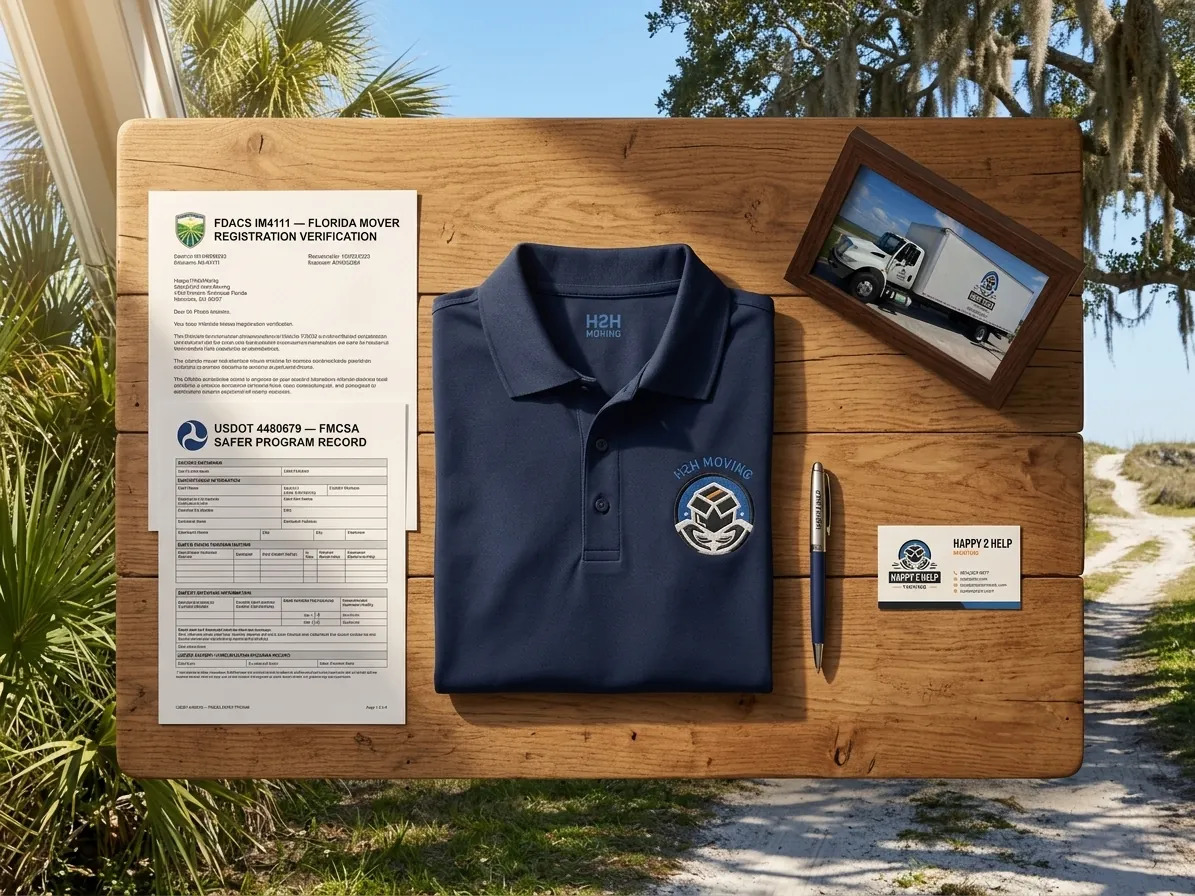
H2H Moving operates intrastate in Florida under FDACS IM4111 and USDOT 4480679, with the insurance and consumer-protection compliance required for legitimate Florida household goods moving. Happy 2 Help operates under FDACS IM4111 (Florida Mover Registration) and USDOT 4480679 — both verifiable on the public registries. We do not hold MC operating authority, so long-distance corridors are presented as informational guides until that authority is granted.
This is itself a sign of credibility: a mover that pretends to have licensing they don’t hold is the bigger red flag. A mover that says clearly “here’s what we have, here’s what we’re working on, verify any of it independently at FDACS or sunbiz” is the one to trust.
To verify any Florida mover’s current registration status — including H2H once our IM number is current — search at fdacs.gov/Business-Services/Movers. Verify business registration at sunbiz.org. For interstate authority, check safer.fmcsa.dot.gov.
The bottom line
Hiring a licensed Florida moving company isn’t optional — it’s the difference between a stress-tested, insured, accountable operation and a roll of the dice. The 5-minute FDACS + sunbiz verification check is the single highest-ROI consumer-protection step you can take before any Florida move.
Got questions about a specific mover or about Florida licensing? Call (904) 209-9277 or request a quote. We’re happy to walk you through what to verify and what to ask. H2H Moving serves all of Northeast Florida — St. Augustine, Ponte Vedra Beach, Nocatee, and the broader region.
Related reading: Best movers in St. Johns County 2026 · 5 expert tips for a stress-free move · HOA gate approval guide · Our packing services
Frequently Asked Questions
How do I verify a Florida moving company is licensed? add
Search the Florida Department of Agriculture and Consumer Services (FDACS) Movers database at fdacs.gov/Business-Services/Movers. Every legitimate household goods mover operating intrastate in Florida must register under Florida Statute Chapter 507. Cross-verify the business itself at sunbiz.org (Florida Division of Corporations) — active status, registered agent, and owner name should match the mover's website. For interstate moves, check USDOT and MC operating authority at safer.fmcsa.dot.gov.
What is Florida Statute Chapter 507? add
Florida Statute Chapter 507 is the state law that regulates household goods movers operating intrastate in Florida. It requires movers to register with FDACS, maintain insurance, provide written estimates, follow specified consumer-protection rules around invoice transparency and claim procedures, and submit to dispute-resolution oversight by the FDACS Bureau of Consumer Services. Violations can result in fines, license suspension, or revocation. Chapter 507 is the consumer-protection backstop for any intrastate Florida move.
What's the difference between FDACS, USDOT, and FMCSA? add
FDACS (Florida Department of Agriculture and Consumer Services) regulates intrastate household goods movers operating within Florida under Florida Statute Ch 507. USDOT (United States Department of Transportation) issues a number to any commercial motor carrier operating interstate. FMCSA (Federal Motor Carrier Safety Administration) is the federal agency that regulates interstate carriers, issues MC operating authority, and maintains the SAFER database for verifying interstate movers. Intrastate Florida moves: check FDACS. Interstate moves crossing state lines: also check USDOT and MC operating authority.
What are the actual risks of hiring an unlicensed mover? add
Hostage shipments (truck arrives at destination, driver demands additional thousands in cash before unloading), uninsured damage (mover claims they're not insured for breakage, you have no recourse), bait-and-switch quotes (initial estimate triples after loading), disappearing trucks (deposit paid, day of move no one shows up, phone disconnected), and unvetted crews (no background checks, no workers comp, no employer-of-record). All five are documented patterns in the unlicensed-mover space. Licensing through FDACS or FMCSA is the regulatory backstop that prevents or resolves these scenarios.
Does H2H Moving have all the licenses? add
H2H Moving operates intrastate in Florida under FDACS IM4111 and USDOT 4480679, with the insurance and consumer-protection compliance required for legitimate Florida household goods moving. Happy 2 Help operates under FDACS IM4111 (Florida Mover Registration) and USDOT 4480679 — both verifiable on the public registries. We do not hold MC operating authority, so long-distance corridors are presented as informational guides until that authority is granted. To verify any Florida mover's licensing status (including ours when our number is current), search at fdacs.gov/Business-Services/Movers. For interstate operating authority, check safer.fmcsa.dot.gov. We welcome the scrutiny — verification is exactly what licensing exists to enable.
Planning a move? Talk to a real person.
Happy 2 Help Moving is locally owned and owner-operated by Devin Vangel in St. Augustine, FL. Free quotes, no pressure.
Get a Free Quote arrow_forwardor call (904) 209-9277