Apartment Moving: Southside, Baymeadows, Town Center
High-rise and walk-up apartment moving for Duval County: COI requirements, elevator reservations, parking, and corridor-by-corridor specifics.
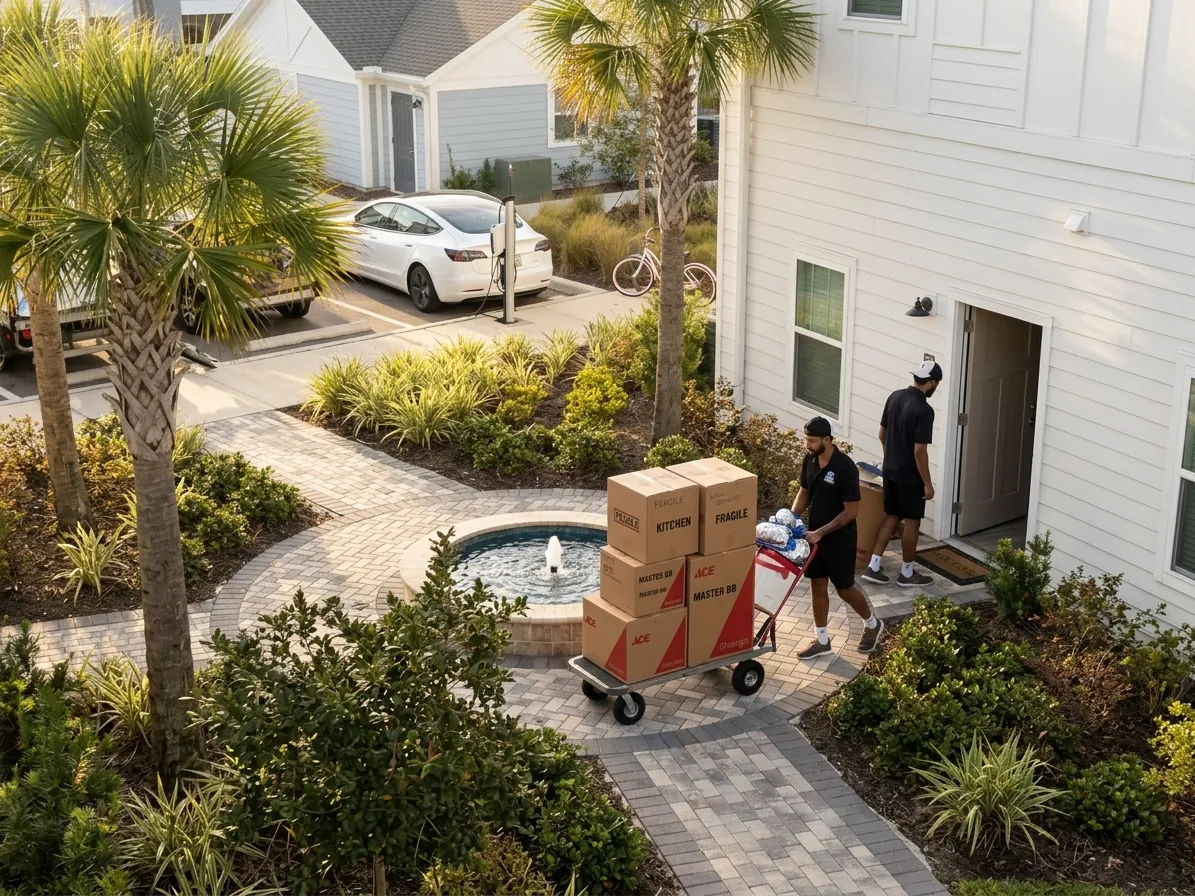
Apartment moving is its own thing in Jacksonville
A four-bedroom house move and a one-bedroom Southside high-rise move have wildly different operational profiles. The house is a ground-floor truck pull-up, three crew, six-hour day. The apartment is a 40-minute elevator-reservation block, a 200-foot corridor walk, a Certificate of Insurance attached to the gate-access form, and a parking-garage geometry problem.
If you’re renting in Duval County and planning a move within or out of Jacksonville in 2026, this guide is for you. We cover the corridor-by-corridor realities of the highest-volume apartment markets — Southside, Baymeadows, Town Center, the Beaches, and downtown — and what differs from a typical house move.
This is a local moving post focused on apartment-specific operations. For broader residential moving context, the service page has the formal breakdown.
What Jacksonville apartment property managers require
The standard documentation checklist that most class-A and class-B Jacksonville apartment communities enforce:
1. Certificate of Insurance (COI)
The single most common reason a move gets turned away at the gate. Property management requires a COI naming the apartment ownership entity as additional insured. Typical requirements:
- General liability: 1-2 million per occurrence
- Workers compensation: statutory minimum
- Auto liability: 1 million
- Submitted 24-72 hours before move day
A licensed Florida mover with proper insurance can issue a COI same-day on request. A mover that dodges the question or claims it’s not necessary is the wrong mover. Forward your property management’s specific COI requirements to your mover during the estimate phase so there’s time to issue the certificate.
2. Elevator reservation
For any building above two stories, an elevator reservation is mandatory. Contact property management 2-3 weeks ahead. Reserve the freight elevator or designated moving elevator for a specific window — typically a 4-hour block. Move days are usually weekday-only at high-rise buildings, with limited Saturday morning availability. Sunday is often prohibited.
Lock the reservation in writing. Forward the confirmation to your mover. If the window slips, the next available may be days out — apartments don’t have spare elevator capacity to absorb missed windows.
3. Parking permit / loading zone reservation
Some buildings have designated loading zones; others require coordination with property management or city Parking Authority for short-term truck parking. Downtown Jacksonville high-rises and dense Southside complexes both enforce parking compliance. Get the permit or reservation arranged in advance.
4. Security deposit (apartment damage)
Some buildings require a refundable security deposit (typically a few hundred dollars) returned after damage-free move-out walkthrough. Plan for this in your budget.
5. Move-out checklist / damage walkthrough
Property management typically conducts a damage walkthrough either at move-out or shortly after. A good moving crew leaves no scuffs, no door-frame damage, no broken light fixtures — but document the apartment condition before and after with photos as your evidence base.
Corridor-by-corridor specifics
Southside (I-95 / J. Turner Butler Boulevard corridor)
Highest-volume Jacksonville apartment market. Dense mix of newer mid-rise garden-style complexes, larger institutional ownership, and several high-rises. The Markets at Town Center area concentrates a lot of newer apartment inventory.
- Most communities enforce COI requirements
- Parking is generally onsite garage; loading zones designated
- Elevator reservations standard at 4+ story buildings
- Move-day traffic on JT Butler Boulevard can add transit time — plan crew arrival early
Baymeadows (Baymeadows Road corridor)
Older established apartment market between I-95 and Old St. Augustine Road. Mix of garden-style, mid-rise, and several high-density complexes. Generally more flexible than Southside on logistics — some older complexes don’t enforce strict COI policies, though property management is shifting toward stricter compliance.
- COI required at newer / institutionally-owned properties
- Parking is mostly onsite
- Mid-rise elevator reservations standard
- Easy access from I-95 and US-1
Town Center (St. Johns Town Center area / Gate Parkway)
The newest apartment-development cluster in Jacksonville. Class-A institutional ownership. Strict COI enforcement.
- COI required, usually 48-72 hours in advance
- Parking strict — loading zones designated, enforcement is real
- Elevator reservations mandatory at all multi-story buildings
- Move windows often limited to weekday-business-hours
Downtown Jacksonville (high-rise district)
The Riverwalk, San Marco-adjacent towers, downtown core high-rises. Most rigid logistics requirements in the city.
- COI requirements strict
- Freight elevator reservations mandatory, often only one window per day available
- Loading-dock access required — no street parking for full-day moves
- Parking permits required from the City of Jacksonville for any street loading
- HOA-like documentation common in condo-converted buildings
Riverside / Avondale (King Street, St. Johns Avenue)
Historic district. Mix of converted-house apartments, small mid-rise developments, and a few larger complexes. Logistics vary widely.
- COI requirements vary by property
- Historic district street geometry can be narrow — 26-foot truck access not always feasible
- Parking permits sometimes required
- Tree canopy can be low — truck clearance check during inventory walk
San Marco (San Marco Square, historic district)
Similar to Riverside in mixed property type. The Square itself is high-end with strict logistics.
- COI required at higher-end buildings
- Parking is the biggest constraint — limited street loading
- Tree canopy and narrow streets
The Beaches (Atlantic Beach, Neptune Beach, Jacksonville Beach)
Garden-style apartment complexes dominate. Some mid-rise oceanfront. Less institutional than Southside or Town Center.
- COI required at newer / institutionally-owned properties
- Beach access traffic affects move-day timing on weekends
- Salt-air storage considerations for any contents going into beach-area storage
Why apartment moves cost more than house moves of identical inventory
Three structural reasons:
- Elevator wait time. Even with a reserved window, crew waits on elevator availability between load cycles. Builds up to 30-90 minutes of additional time on a full move.
- Long carry. Truck to apartment door is usually a longer walk than truck to house door. Parking garage, ground-floor entrance, corridor walk. Adds time per cycle.
- Window constraint. Apartment moves must fit the property-management-approved window. Crews can’t extend the day if needed without coordinating with property management — and the answer is often no.
Practical impact: a 1-bedroom that would be a 4-hour house move is often a 6-hour apartment move with identical inventory. Estimates should reflect this honestly on the line items.
What H2H Moving handles for Jacksonville apartment moves
Standard practice on any Jacksonville apartment move:
- COI issued to property management 48-72 hours before move day
- Crew arrival aligned to elevator reservation window
- Pre-move address inspection (in-home or video walk) to identify access constraints
- Materials and padding to protect doorframes, corridor walls, elevator interiors
- Damage walkthrough documentation at origin and destination
- Same-day apartment-to-apartment moves within Duval County
For an apartment moving estimate, call (904) 209-9277 or request online. We serve all of Duval County — Jacksonville, San Marco, Riverside, Mandarin, Atlantic Beach, and the broader Jacksonville metro.
Related reading: Cost to move in Northeast Florida 2026 · Why hire a licensed Florida moving company · Packing for a Florida summer move · Our apartment moving service · Our residential moving service
Frequently Asked Questions
Do Jacksonville apartments really require a Certificate of Insurance from movers? add
Most class-A and class-B Jacksonville apartment communities do — and they enforce it. Property management typically requires a Certificate of Insurance (COI) naming the apartment ownership entity as additional insured, with minimum liability limits commonly set at 1 to 2 million dollars. The COI must be submitted 24 to 72 hours before move day. Movers who can't or won't provide a COI can be turned away at the gate, costing you the move day. Major Jacksonville-area communities enforcing COI policies include most Southside, Baymeadows, Town Center, and downtown high-rises. Independent landlord-owned properties and smaller complexes are more flexible. Always ask your property manager what they require and forward the requirements to your mover during the estimate phase.
How do I reserve an elevator for a Jacksonville high-rise move? add
Contact property management two to three weeks before move day. Reserve the freight elevator or designated moving elevator for a specific window — typically a four-hour block. Most Jacksonville high-rise buildings restrict moving to weekdays, with some allowing Saturday morning windows. Sunday moves are often prohibited entirely. The elevator reservation locks in your loading window — if you miss it, the next available block may be days out. Confirm in writing with property management and forward the confirmation to your mover. Buildings commonly require padded elevator protection (provided by property), a security deposit refundable on damage-free completion, and check-in with the front desk before access.
Why are Jacksonville apartment movers more expensive than house movers? add
Three factors. First, elevator time — every load cycle takes longer than a ground-floor house because crew waits on elevator availability between trips. Second, long carry — the walk from truck to apartment door is usually longer than from truck to house door (parking garage, ground-floor entrance, corridor walk). Third, scheduling constraint — apartment moves must fit within the property-management-approved window, so crews can't extend the day if needed. Practical impact: a one-bedroom Jacksonville house move that takes 4 hours may take 6 hours as a high-rise apartment move with identical inventory. Your estimate should reflect these realities on the line items.
What apartment corridors does H2H Moving serve in Jacksonville? add
All of Duval County. The highest-volume corridors are Southside (the I-95 / J. Turner Butler Boulevard corridor, including The Markets at Town Center area), Baymeadows (the Baymeadows Road corridor between I-95 and Old Saint Augustine Road), Riverside and Avondale (King Street and St. Johns Avenue corridors), San Marco (San Marco Square and the historic district), Downtown Jacksonville (high-rise district), and the Beaches (Atlantic Beach, Neptune Beach, Jacksonville Beach apartment complexes). Mandarin, Arlington, and the Westside also have significant apartment-community concentrations. Each corridor has specific access patterns we plan around.
How early should I book a Jacksonville apartment move? add
Three to five weeks ahead for peak windows (end-of-month, summer, weekends). Two to three weeks ahead for off-peak windows (mid-month, mid-week, off-season). Apartment moves have less scheduling flexibility than house moves because the property-management-approved window can't be adjusted on short notice. Booking earlier locks in your preferred crew arrival time and gives you margin to coordinate elevator reservations, COI submission, and parking permits. Last-minute apartment moves (under one week) are often only possible mid-week mid-month and may require accepting whatever crew arrival window is available.
Planning a move? Talk to a real person.
Happy 2 Help Moving is locally owned and owner-operated by Devin Vangel in St. Augustine, FL. Free quotes, no pressure.
Get a Free Quote arrow_forwardor call (904) 209-9277