Commercial Service

Restaurant Equipment Moving in St. Johns County and Jacksonville

Licensed trades release every connected unit first. Then we move the freestanding equipment, smallwares, and dining room to your new layout.

(904) 209-9277
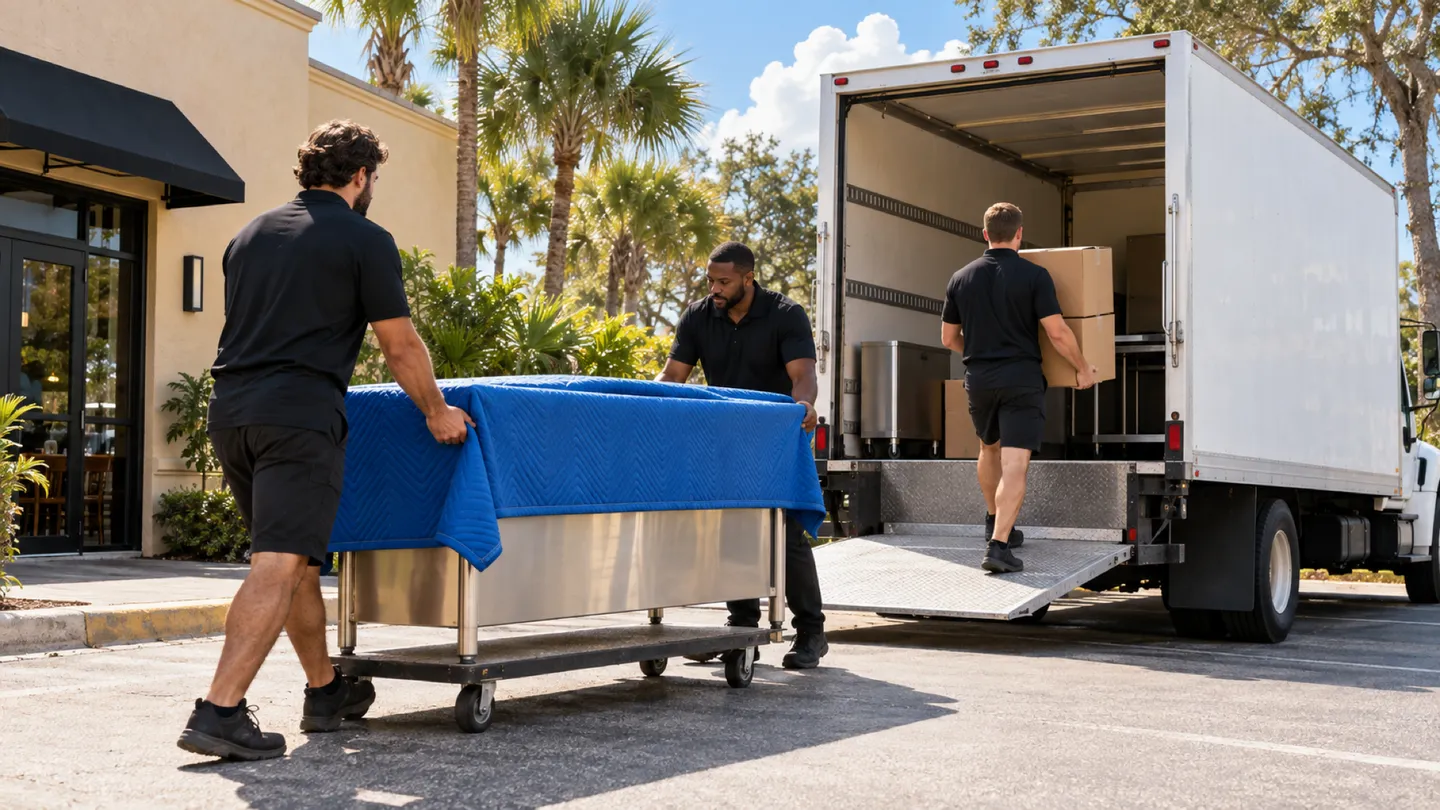
Restaurant Equipment Moving moving in St. Johns County and Jacksonville: moving crew at work
  • Licensed & Insured Fully Covered
  • Owner-Operated By Devin Vangel
  • Northeast Florida St. Johns + Duval + Beyond

Start your free commercial move quote

verified For estimate purposes only credit_card_off No credit card required

How We Plan Restaurant Equipment Moving

Moving a commercial kitchen is mostly a question of order. Every range, fryer, reach-in, ice machine, and dish machine is tied to the building by something: a gas supply, plumbing and a drain, a refrigerant circuit, or a dedicated electrical connection. None of that is mover’s work. The hood, its fire-suppression system, the walk-in cooler, and the grease trap belong to the building and stay behind.

So the service begins after the trades. Once your plumber or gas contractor has made the gas side safe, your refrigeration technician has shut down the cold units, and an electrician has pulled any hardwired equipment, each unit is released to us as a freestanding piece. We measure it against the back door and every turn, strap doors shut, protect the stainless, and carry it on appliance dollies to the truck. Prep tables, speed racks, and carts follow, then the washed smallwares, then the dining room. At the new kitchen we set each unit on its marked position so the trades can reconnect it, and the dining room goes in by your seating plan.

Who usually signs off
Restaurant owner or general manager who approves the equipment inventory, vendor appointments, and service closure
Timing that works
After final service and trade release, before vendor setup at the new kitchen; evening or weekend loading by arrangement, with a storm-season backup date

What typically moves

  • Released ranges, fryers, and griddles Moved only after your gas contractor releases them; grease is drained and cooled by your staff, and casters or legs are protected for the carry.
  • Reach-in and undercounter refrigeration Emptied, cleaned, and released by your refrigeration tech, then kept upright in the truck as the maker specifies.
  • Stainless worktables and wall shelving Undershelves and brackets labeled to their table; freestanding shelving comes apart at its posts for the carry.
  • Speed racks and utility carts Pans and trays boxed separately so nothing slides out on the ramp.
  • Pots, pans, hotel pans, and utensils Packed by station after the final wash and dry, heaviest items low in each carton.
  • Dining tables, booths, and chairs Freestanding booths and loose seating tagged by section; bolted banquettes wait for your contractor.
  • Host stand and point-of-sale counters Terminals are shut down by your provider first; we carry the empty stand and counters.

Access and scheduling

Restaurants usually move straight after the last service, so we plan backward from the final ticket. Staff clean down and empty the cold units that night; the trades disconnect, ideally before our crew arrives; we carry released equipment and the dining room in the same session. If one trade can’t come until morning, everything already cleared moves first and the connected unit waits.

Most kitchens back onto a shared service lane or a rear door by the dumpster enclosure, and neighboring tenants still need their deliveries. We confirm the loading position and hours with both landlords before booking, and send the new building an insurance certificate if its lease asks for one. Summer heat in a closed kitchen and on the lane is punishing, so we start early. Between June and November, pick a second date with your trades as well as with us, since they may be committed elsewhere after a storm.
Protection and handling

Commercial equipment is heavy for its size and top-heavy on a dolly, and the kitchen floor is often still slick after the final washdown. We lay dry runners, strap each unit to the dolly, and move it at walking pace with a spotter on door frames and ramps. Stainless sides are wrapped to prevent scratches and dents, and doors are taped shut so they can’t swing open on a turn.

Refrigeration travels upright unless your technician says otherwise, because compressor oil can migrate if a unit is laid down. We do not stack equipment in the truck. Glassware and china are cushioned in cell cartons; knives go in a closed box your chef packs. Food and ice never ride on our truck. At the new kitchen, each unit is set down near its connection point and left for the trade, not pushed into place against a live line.

Who does what

Some of this job belongs to other trades. The written plan names each one.

Gas lines to ranges, fryers, ovens, and water heaters
A licensed plumber or gas contractor caps them at the old kitchen, then hooks up and leak-checks each appliance in the new kitchen.
Refrigeration, ice machines, and dish machines
Your refrigeration and equipment technicians shut down, drain, and release them, then reconnect and start them up after placement.
Hood, fire suppression, walk-in cooler, and grease trap
These stay with the building. Any new installation is handled by the hood contractor, fire-protection vendor, or refrigeration contractor.

Not part of our work

  • Any work on gas, plumbing, drains, refrigerant circuits, or electrical service, at either kitchen.
  • Removing or installing hoods, suppression systems, walk-ins, or bolted booths.
  • Transporting food, ice, or alcohol.

Around St. Johns County and Jacksonville

Kitchens here sit behind strip centers along A1A and US-1, in the retail blocks around Nocatee Town Center and St. Johns Town Center, in Riverside and San Marco storefronts, and in St. Augustine’s historic district, where rear access can be a narrow alley and early mornings are the practical window.

The crew that shows up

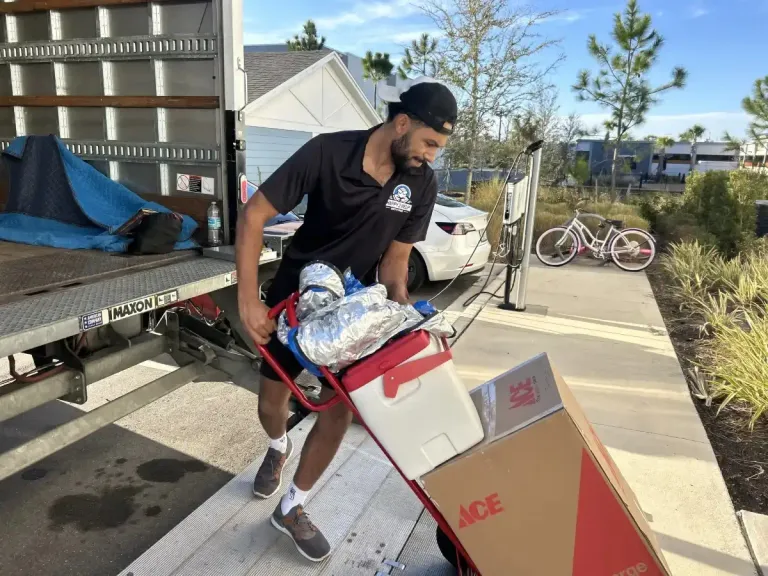
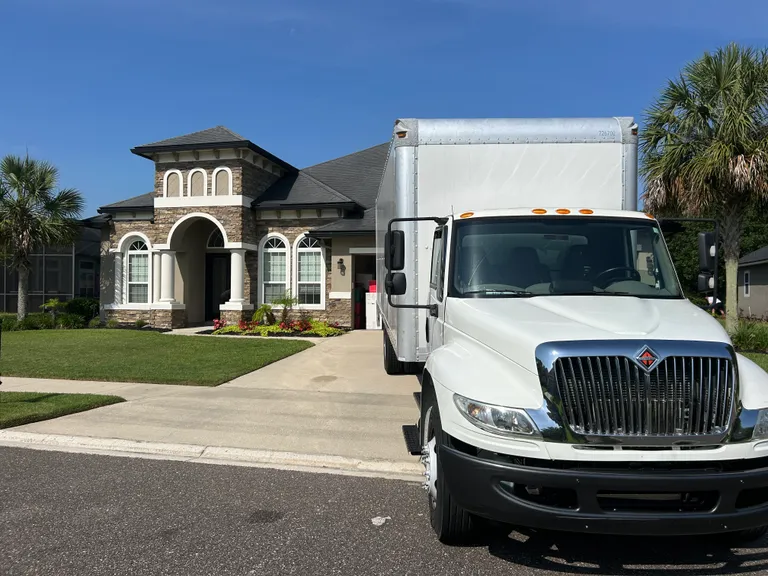
Mover in a black polo pulling a loaded hand truck off the liftgateWhite box truck at the curb outside a home with palm trees

Restaurant Equipment Moving FAQs

Another question? Call (904) 209-9277.

Can a reach-in cooler lie on its side in the truck?

We keep refrigeration upright unless your refrigeration technician tells us otherwise for that model, because oil can move out of the compressor when a unit is laid flat. If a unit won’t clear a door standing up, the technician decides whether doors or casters come off, or whether it waits for another approach.

Our fryers are on a gas quick-disconnect. Can your crew unhook them?

No. Even with a quick-disconnect hose, the gas side is for your licensed plumber or gas contractor, who shuts it off, caps it, and checks for leaks. Once they release the fryer and your staff have drained and cooled the oil, we move it.

What happens to the ice machine and its bin?

Your equipment or refrigeration technician shuts it down, drains it, and takes it off its supply and drain. We move the head and bin as separate released pieces and set them at the new position for the technician to reconnect and sanitize before first use.

Can the dining room be set up while trades work in the new kitchen?

Yes, that is a common way to save a day. The dining room and host stand go in by your seating plan while the kitchen is left clear for the trades. We place kitchen equipment first thing, then leave the back of house to them.

Plan your business move

Tell us both addresses, the building rules you know about, and the dates you cannot move. We will send back a written plan and estimate.

Call (904) 209-9277

Mon–Sun 8:00 AM – 7:00 PM

Call Now call 904-209-9277